The meter is on, AI is becoming infrastructure spend
AI assistants were sold as flat subscriptions, but long-running agents have variable inference cost. GitHub's move to usage-based Copilot billing is a sign AI spend is becoming cloud spend, here's how to budget for it.
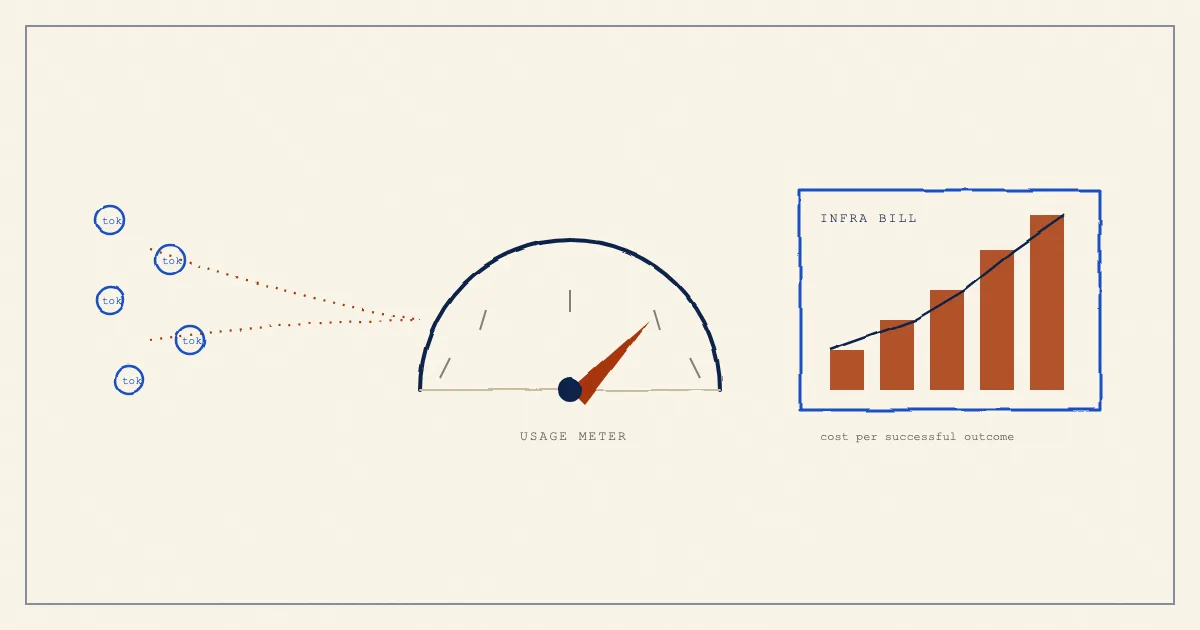
For the first couple of years of the AI assistant boom, the pricing model felt reassuringly familiar: pay a flat monthly fee, use the tool as much as you want. That framing made sense when “using the tool” meant a developer asking a chat window the occasional question. It stops making sense once the thing you’re running is a long-running agent making dozens or hundreds of model calls per task, with cost that scales directly with how much work the agent actually does.
The signal: Copilot moves to usage-based billing
In 2026, GitHub announced that Copilot is moving to usage-based billing: plans now include a bundle of AI credits, with metered billing for usage beyond that allotment, effective June 1, 2026. That’s a meaningful shift in framing. A flat subscription hides variable cost from the user, the vendor eats the variance. Usage-based billing surfaces it, the customer now sees, line by line, that heavier AI usage costs more to serve, because it genuinely does cost more to serve.
This isn’t really a story about GitHub specifically. It’s a leading indicator of where AI tooling pricing is headed generally: the flat-fee era made sense for chat-shaped usage, and it stops making sense once “usage” means an agent that might call a model fifty times to complete one task versus five times for an easier one. The cost structure underneath was always variable. The pricing model is catching up to that fact.
Think about it like cloud spend, because it is cloud spend
The useful shift here isn’t just emotional (“the free lunch is ending”), it’s practical. AI inference cost behaves like cloud infrastructure cost: it scales with usage, it’s measurable per unit, and it needs the same budgeting discipline teams already apply to compute, storage, and bandwidth. Concretely, that means:
- Measure tokens like you measure requests. If you don’t know how many tokens a typical agent task consumes, you can’t predict cost as usage grows. Instrument it the same way you’d instrument request counts or database query volume.
- Cap agents, not just users. A single runaway agent loop, one that keeps retrying, keeps expanding its own context, keeps calling tools it doesn’t need, can burn far more budget than a human would in the equivalent time. Set hard limits on calls-per-task or tokens-per-task, the same way you’d set a timeout on a long-running job.
- Cache safely. Prompt caching can cut cost substantially when the same context gets reused across calls, but only if your prompt structure keeps a stable prefix. Restructuring prompts in ways that break caching is an easy, invisible way to pay more than you need to.
- Track cost per successful outcome, not cost per call. A cheap call that fails and needs three retries is more expensive than one slightly pricier call that succeeds the first time. The unit that actually matters for budgeting is cost per completed task, not cost per model invocation.
- Separate experimentation budget from production budget. Prototyping and prompt iteration naturally burn tokens in ways that shouldn’t be conflated with the steady-state cost of a shipped feature. Track them separately or experimentation spend will quietly distort your sense of what production actually costs.
What this doesn’t mean
This isn’t a claim that AI tooling is becoming unaffordable, or a prediction about any specific vendor’s margins or pricing roadmap beyond what’s been publicly announced. It’s narrower than that: the pricing model is shifting from flat to metered because the underlying cost structure was always metered, and teams that haven’t built the instrumentation to track their own usage are going to be the ones most surprised by a line-item bill once their vendor makes that shift too. The fix isn’t waiting for pricing to change back it’s budgeting for AI spend the way you already budget for cloud spend, before the meter makes it mandatory.